
The 7C Framework is a bidirectional life-development system contained within LifePrint (LP). Its up-flow builds from Life Around (LA)—CORE, extended family, crust, and environment—through Business (BU), Career (CA), Finances (F), and Body–Mind–Spirit (BMS), culminating in Univerself (US) as ultimate reality. Its down-flow returns guidance from US through Spirit, Mind, and Body into finance, career, business, environment, networks, family, and CORE, ensuring that higher awareness continuously refines daily life. LP preserves the continuity, footprint, and legacy of this full cycle.
Why Most Life Frameworks Fall Short
Most life frameworks look like ladders. You start at the bottom, move upward, and hope that reaching the top means you are successful. The problem is that real life does not work like that. Even if you grow in your career, build a business, or become financially secure, you still have to come back to your daily life—your health, your relationships, your community, and the way you live each day. If the “top” of life does not improve the “bottom,” then the progress is incomplete.
The Core Idea of the 7C Framework
That is the core idea behind the 7C Framework. It is built as a closed-loop system that works in two directions. One direction builds capacity over time. The other direction brings guidance back down into everyday living. The whole system sits within something called LifePrint, which serves as a container for meaning, memory, and legacy.
Up-Flow: How Growth Builds Step by Step
The first direction is the up-flow. This is the path of development that most people recognize. It starts from the core of your life—your closest relationships and your immediate environment—and moves upward through the practical layers of work and stability, then into inner growth and deeper meaning. In the 7C model, the up-flow goes from the core family unit to extended family, then to friends and professional networks, and finally to the wider environment you live in. From there, it moves into business, career, and finances, and then into body, mind, and spirit. Finally, it reaches Univerself, which represents the highest level of orientation—your sense of truth, ethics, and connection to something larger than yourself.
Down-Flow: Bringing Guidance Back Into Daily Life
The second direction is the down-flow. This is where the model becomes more realistic than a ladder. The down-flow begins at Univerself and moves back down through spirit, mind, and body, then into finances, career, business, and back into the environment and relationships. The purpose of this direction is correction. It makes sure that what you learn at the higher levels—about values, ethics, clarity, and meaning—actually changes how you behave and what you build. If your spiritual or ethical understanding does not improve how you treat your family, handle money, work, or design your business, then it remains only an idea.
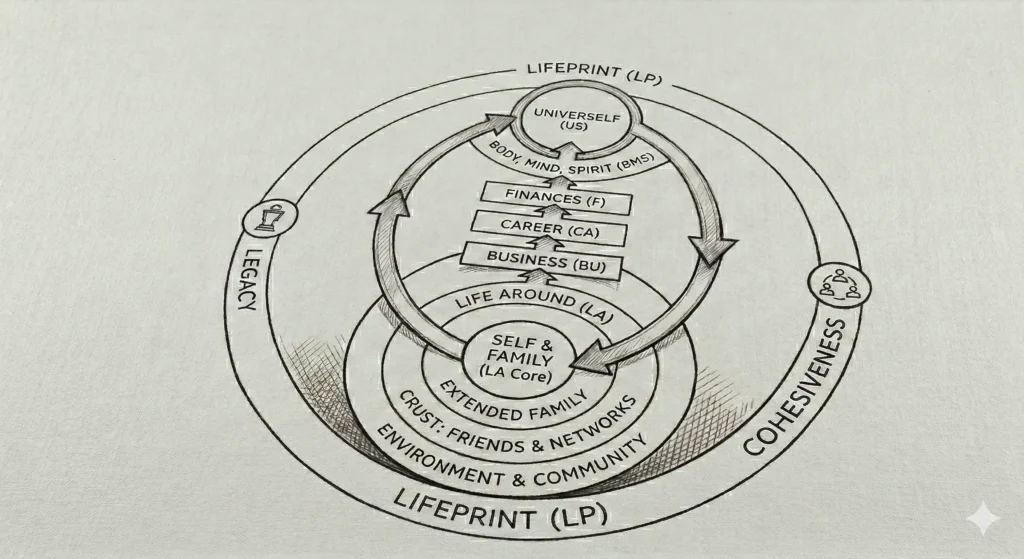
LifePrint (LP): The Container That Holds the Whole System Together
LifePrint, or LP, connects both flows together. You can think of LifePrint as the memory and continuity layer of the whole system. It records not only what you achieved, but also what you learned, what you corrected, and how your values evolved over time. Without LifePrint, life becomes repetitive. People make progress, experience setbacks, forget lessons, and start again. LifePrint prevents that by keeping a clear trail of decisions, patterns, and meaning. It also adds an important measure: success is not only about output, but also about footprint, legacy, and cohesiveness. In other words, what you built matters, but how you built it matters as well.
LP — LifePrint (Container of Both Flows)
- Define LP as the container for the entire 7C loop (up-flow + down-flow), so that the framework is treated as one integrated life system rather than as isolated categories.
- Use LP to preserve continuity across layers (memories, decisions, lessons, values, patterns), so growth in any layer can inform the others over time.
- Record both ascent and correction: not only achievements (up-flow), but also reflections, ethical corrections, and course changes (down-flow).
- Measure LP as footprint + legacy + coherence, so success is evaluated by what was built, how it was built, and what it leaves behind.
- Review LP cyclically (not linearly), because the framework is iterative: every higher insight must return to improve lower layers.
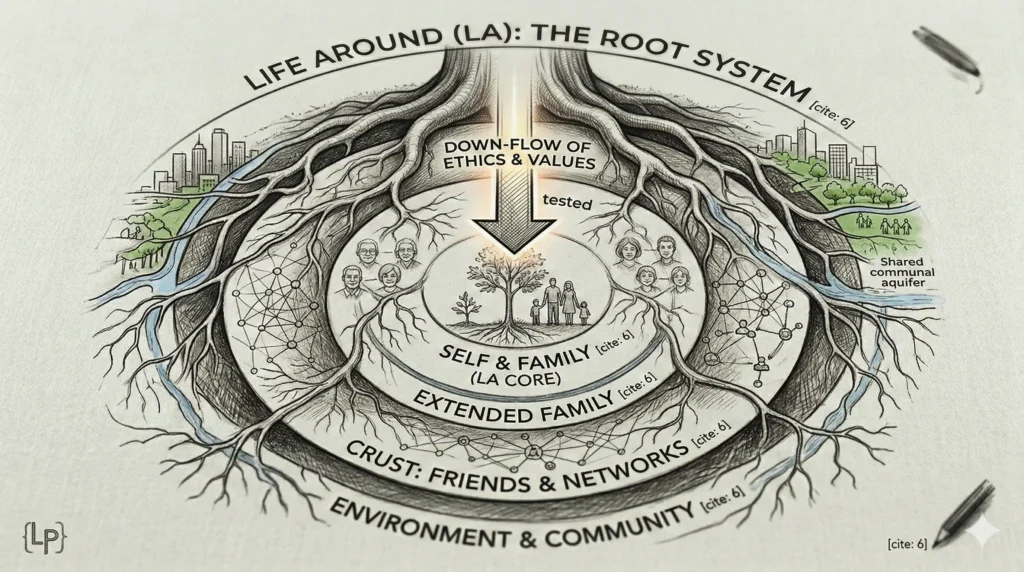
Life Around (LA): The Root System of the Framework
The framework’s foundation is Life Around (LA). This is not a single idea. It has four layers that move outward. The first is the core—yourself, your spouse, and your children. The second is the extended family. The third is the “crust,” meaning friends, colleagues, and professional and social networks. The fourth is the environment, which includes the community you live in and the broader ecosystem around you. LA is called the root system for a reason. If the core is unstable, everything above it becomes fragile. A successful career built on constant conflict at home or broken trust in close relationships will eventually fall apart. The model also makes an important point: LA is not only where growth begins. It is also where down-flow is tested. If your highest understanding does not translate into better relationships, clearer boundaries, more dignity, and healthier community life, then the “higher” part of the framework is not doing its job.
LA — Life Around (Foundational Root System)
Substructure: CORE → Extended Family → Crust → Environment
LA is the root ecology of the whole system. It is the starting point of the up-flow and also the landing point of the down-flow.
1) CORE (self/spouse/children)
- Protect trust, dignity, and emotional safety in the CORE because the up-flow begins here; instability at this level weakens every higher layer.
- Establish shared life rules in the CORE (respect, consent, privacy, conflict hygiene), because the downward flow from US must first become visible in the closest relationships.
- Preserve core memories, values, and lived truths so LP begins from reality, not abstraction.
2) Extended Family
- Maintain respectful, bounded ties with extended family because this layer stabilizes the CORE during transitions and crises.
- Create intergenerational exchange channels (stories, wisdom, support), because LP becomes stronger when values move across generations.
- Apply down-flow ethics as boundary intelligence: compassion with limits, support without intrusion.
3) Crust (friends, colleagues, networks)
- Build a trustworthy social/professional crust because this is the bridge from private life (family) to public value creation (BU/CA).
- Choose networks that reinforce values and growth so that the downward flow from the US (ethics/purpose) shapes social exposure, not just private belief.
- Practice cooperation across diverse groups because this layer becomes the partnership engine for BU and CA.
4) Environment (place, community, ecosystem context)
- Live in and contribute to a healthy environment because the quality of the place directly affects body, mind, finances, and relationships.
- Treat the environment as part of LA, not external to life, because your surroundings are a daily force acting on the CORE and crust.
- Use down-flow awareness to shape environmental behavior (consumption, civic responsibility, stewardship, legality), so higher values become visible in local living.
LA in the updated model:
LA is not only the starting layer. It is also where the down-flow is tested. If US insight does not improve CORE/family/community/environment, it is incomplete.
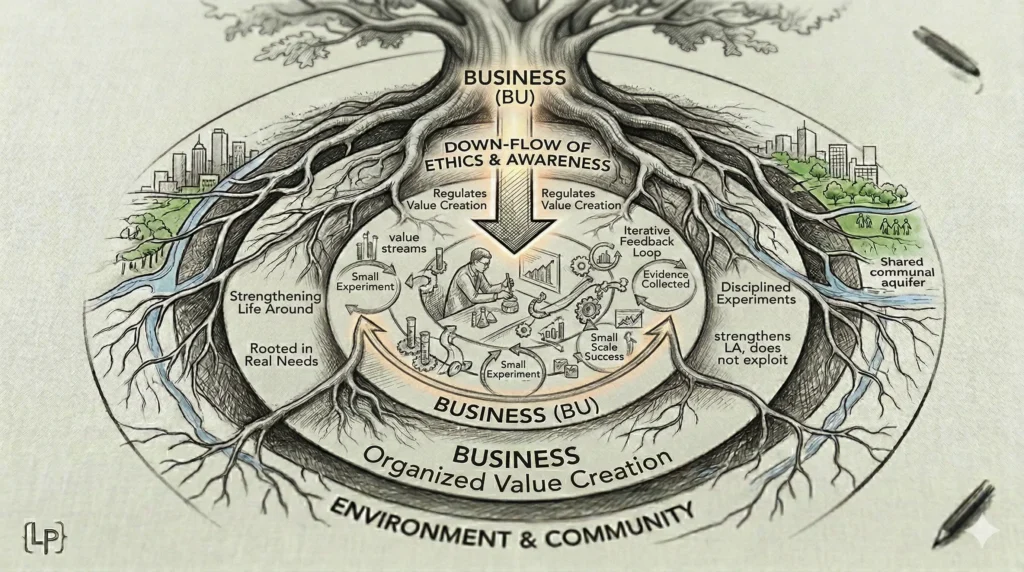
Business (BU): Value Creation That Should Strengthen Life Around
Once Life Around is stable enough, the model moves into Business, or BU. Here, business does not mean only entrepreneurship. It means organized value creation—creating something that solves real needs and can be delivered reliably. BU is placed above LA because good business is usually rooted in real life: the needs people face, the trust they share, and the problems they want solved. The framework insists that businesses should strengthen Life Around, not exploit it. That is why the down-flow matters here. Ethics and awareness should regulate how value is created. Businesses should also be disciplined. Instead of chasing large risky moves that create stress and instability, it should run small, evidence-based experiments so growth does not damage finances, health, or relationships.
BU — Business (Structured Value Creation from LA Reality)
BU sits as the first formal transformation layer above LA:
It converts lived needs, trust, and observed problems into organized value.
- Build business initiatives from real LA needs (family, community, and environmental realities), so BU grows from truth rather than chasing trends.
- Use a trust-based business design so the BU strengthens the LA instead of extracting from it.
- Embed sustainability and maintainability in offerings so BU remains aligned with LP and does not create downstream damage.
- Use partnerships through crust/community networks because LA is the natural feeder system for ethical business collaboration.
- Allow downward flow from US/BMS to regulate BU decisions (non-harm, dignity, fairness), so that value creation remains morally coherent.
- Run disciplined experiments so BU growth does not destabilize F, BMS, or LA.
BU role in the loop:
Up-flow: converts social reality into value.
Down-flow: converts ethics into operating principles.
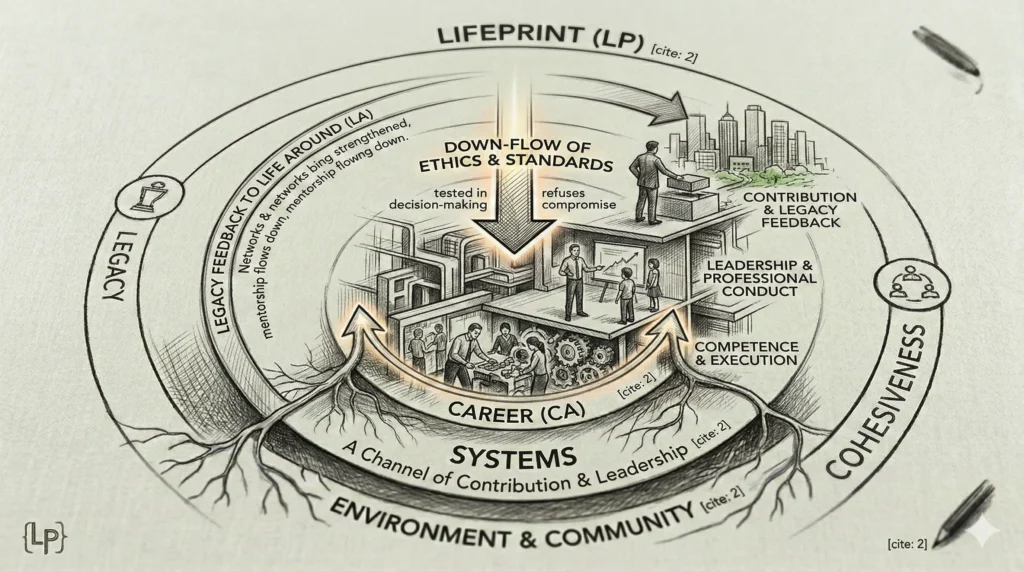
Career (CA): Competence, Execution, and Professional Conduct
Career (or CA) comes next. A career is the layer of competence and execution. It is where capability becomes real performance inside systems—companies, projects, institutions, and teams. The framework treats career as more than status or job title. It frames a career as a channel of contribution, leadership, and professional conduct. A strong career should not destroy your health or erode your family life. It should support them. It should also feed back into Life Around by building better networks and by mentoring others. This is another place where down-flow has a direct role. Your ethics should show up in how you lead, how you make decisions, and the standards you refuse to compromise.
CA — Career (Competent Execution and Professional Identity)
CA is the execution and capability layer that operationalizes BU in real institutions/systems.
- Build mastery and competence to deliver value reliably because CA is the disciplined execution engine for BU.
- Use career as a channel of ethical contribution, not status alone, so the flow from the US shapes professional choices and conduct.
- Choose roles that preserve LA and BMS stability because career success that destroys health or family breaks the loop.
- Develop leadership and mentoring capacity, so CA feeds back into crust/community strength within LA.
- Keep an innovation thread active so CA continues to support BU’s evolution and future resilience in F.
- Use reflective practice in career decisions so mind/spirit insight (BMS + US down-flow) improves professional judgment.
CA role in the loop:
Up-flow: increases capability and role impact.
Down-flow: applies ethics and awareness inside professional systems.
Finances (F): Stability That Supports Better Choices
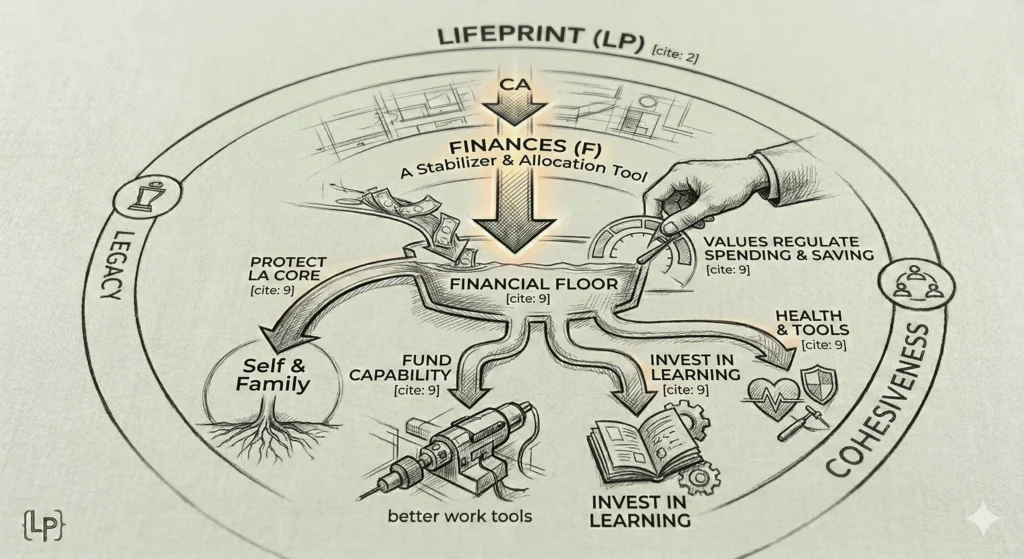
Finances (F) sit between external execution and inner development. That placement is intentional. Financial stability is not treated as the final goal. It is treated as a stabilizer. Without a basic financial floor, people struggle to invest in learning, protect their health, or make thoughtful career choices. They react under pressure. In the 7C model, finances should first protect Life Around—especially the core family unit and basic stability. Money is also an allocation tool. It should fund capability, health, and tools that support better work and better value creation. The downflow shows up again here: values should regulate spending and saving so that money does not become disconnected from purpose or ethics.
F — Finances (Capture, Protection, and Allocation of Value)
F is the stabilization layer between external execution (BU/CA) and inner refinement (BMS).
- Build a financial stability floor (cash flow discipline, reserves, risk control), because without financial safety, the up-flow into BMS becomes fragile.
- Use finances to protect LA first (CORE, family, environment needs), because F is a shield, not only an accumulation tool.
- Allocate funds to capability, health, and tools so F actively supports CA, BMS, and BU growth.
- Practice footprint-aware, values-aligned spending so that LP and US down-flow become visible in daily financial behavior.
- Use financial metrics for clarity, not fear, so mind/body stress is reduced and decisions remain rational.
- Let-down-flow ethics govern money decisions (fairness, non-harm, responsibility), so finance does not become detached from purpose.
F role in the loop:
Up-flow: creates stability for deeper development.
Down-flow: converts values into budget, allocation, and consumption behavior.
BMS: The Inner Development Layer (Body, Mind, and Spirit)
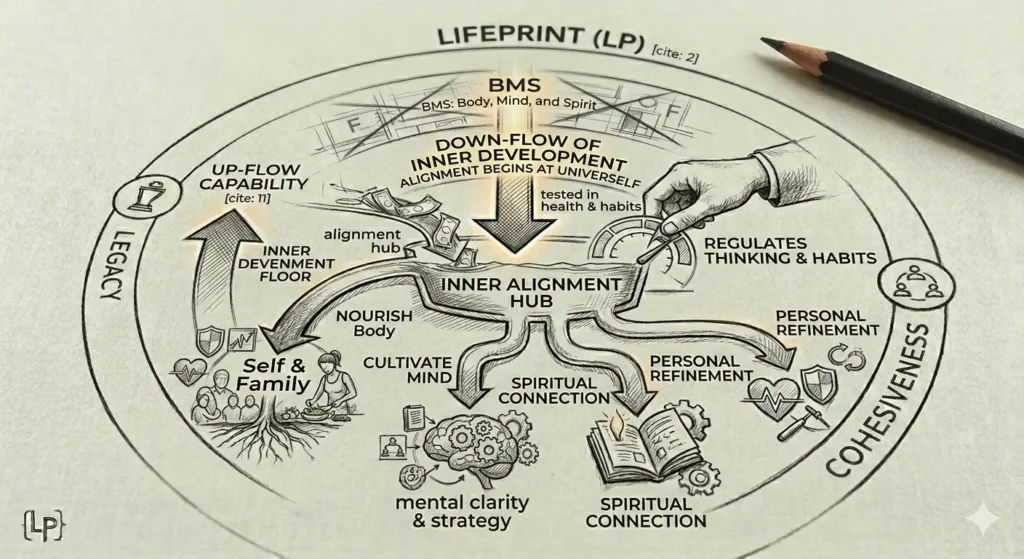
After finances, the framework moves into BMS: body, mind, and spirit. This is the inner development layer, and it has its own two-way movement. The up-flow within BMS goes from body to mind to spirit. That reflects a simple truth: if the body is unhealthy and exhausted, the mind struggles, and consistent spiritual practice becomes difficult. The down-flow within BMS goes from spirit to mind to body, which reflects another truth: spiritual alignment should influence thinking, and thinking should influence daily habits. BMS is where personal refinement happens. It is also a feedback engine for the whole system. When the mind is clear and the spirit is grounded, decisions about money, work, business, and relationships improve. When the body is neglected, everything else becomes harder.
BMS — Body, Mind, Spirit (Inner Refinement and Feedback Engine)
BMS internal sub-flow:
Body ↔ Mind ↔ Spirit within BMS, with:
- Up-flow: Body → Mind → Spirit
- Down-flow: Spirit → Mind → Body
1) Body
- Protect body health as the energy foundation because BU, CA, and F all depend on physical capacity and recovery.
- Stabilize rhythms (sleep, movement, nutrition, hydration) so the mind can function clearly, and the spirit can be practiced consistently.
- Use down-flow from mind/spirit to govern bodily habits (discipline, restraint, care), so the body is not driven only by impulse or pressure.
2) Mind
- Develop clarity, emotional regulation, and structured thinking because the mind interprets all pressure from LA/BU/CA/F.
- Transform experience into insight through reflection, journaling, and pattern recognition, so LP stores wisdom, not just events.
- Receive guidance from spirit and translate it into decisions, making ideals actionable choices in finance, career, and relationships.
- Protect attention from noise and polarization so the down-flow from US and Spirit is not interrupted.
3) Spirit
- Cultivate purpose, humility, gratitude, and alignment because spirit gives meaning and direction to the entire up-flow.
- Integrate success and suffering through spiritual maturity so outer achievement does not produce emptiness or ego inflation.
- Send guidance downward into mind and body so spiritual insight becomes conduct, discipline, and relational quality—not abstract thought.
- Prepare the consciousness for US orientation by moving from identity-centered living toward truth-centered living.
BMS role in the loop:
Up-flow refines the person.
Down-flow humanizes and disciplines all lower systems.
Univerself (US): The Highest Orientation and the Source of Correction
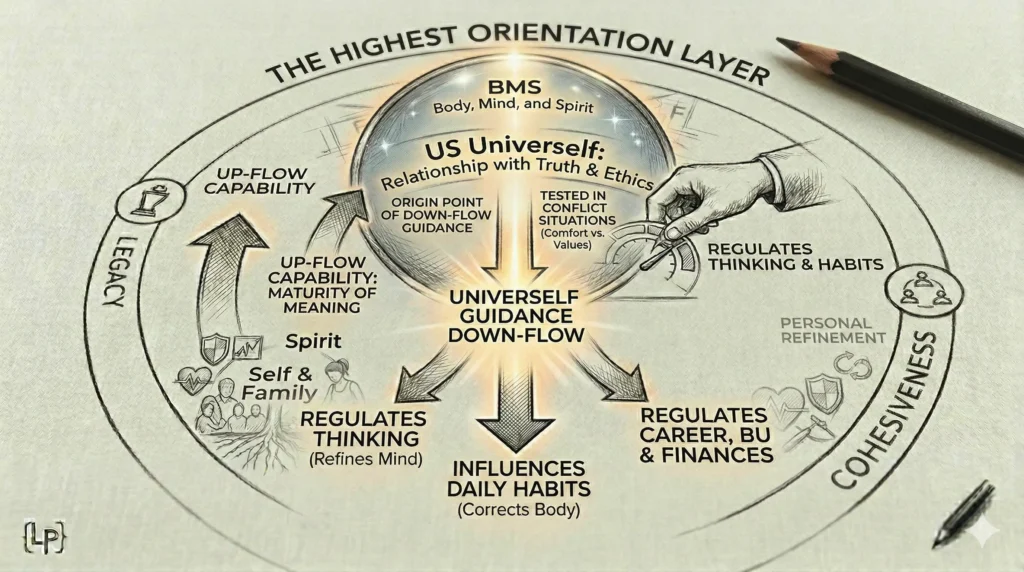
At the top is Univerself, or US. This is not meant as a religious claim. It is a way of naming the highest orientation layer—your relationship with truth, ethics, justice, and connectedness beyond personal self-interest. Univerself is the endpoint of the up-flow because it represents the maturity of meaning. But it is also the starting point of the downflow because it is where the strongest guidance originates. The model treats Univerself as a reference point in conflict situations—when comfort, profit, fear, or status pushes you one way, and values push you another. If Univerself does not shape your choices, it becomes a living force that improves your family life, your health, your work, and the legacy you leave behind. your work, and the kind of legacy you leave behind.
US — Univerself / Ultimate Reality (Highest Orientation and Source of Down-Flow)
The US is both the culmination of the up-flow and the origin of the highest down-flow guidance.
- Treat US as the highest orienting reality, not just another channel, because it defines what all lower-layer growth is ultimately for.
- Use the US as the final reference in conflict situations (when profit, comfort, status, or fear conflicts with truth, dignity, or justice).
- Let US feed Spirit with direction so that spiritual practice remains aligned with reality, not merely emotional consolation.
- Translate US awareness into ethics across the loop: LA (relationships), BU (design), CA (leadership), F (stewardship), BMS (discipline).
- Use US to continuously purify LP (LifePrint) so legacy reflects consciousness and integrity, not only output and achievement.
US role in the loop:
End-point of ascent.
Starting point of correction.
Putting It All Together
When you put these pieces together, the 7C Framework becomes practical. The up-flow explains how life can be built step by step, from stable relationships and environment to value creation, professional execution, financial protection, and inner growth. The down-flow explains how meaning and ethics should return to refine the basics, so growth does not become mechanical or ego-driven. LifePrint holds the full cycle together, so your progress is not lost, and your legacy is shaped with intention.
Up-Flow (Development / Growth / Ascent)
CORE → Ext. Family → Crust → Environment → BU → CA → F → Body → Mind → Spirit → US
Meaning:
- stable relationships and environment create conditions for
- value creation and professional execution, which create
- financial protection and capacity, which support
- inner refinement and spiritual maturation, culminating in
- universal alignment / ultimate reality orientation.
Down-Flow (Guidance / Ethics / Correction)
US → Spirit → Mind → Body → F → CA → BU → Environment → Crust → Ext. Family → CORE
Meaning:
- ultimate truth and spiritual insight refine thought,
- thought disciplines, body, and lifestyle,
- embodied discipline improves finance/career/business decisions,
- ethical execution improves the environment/community,
- and all of it returns to protect and elevate the CORE.